
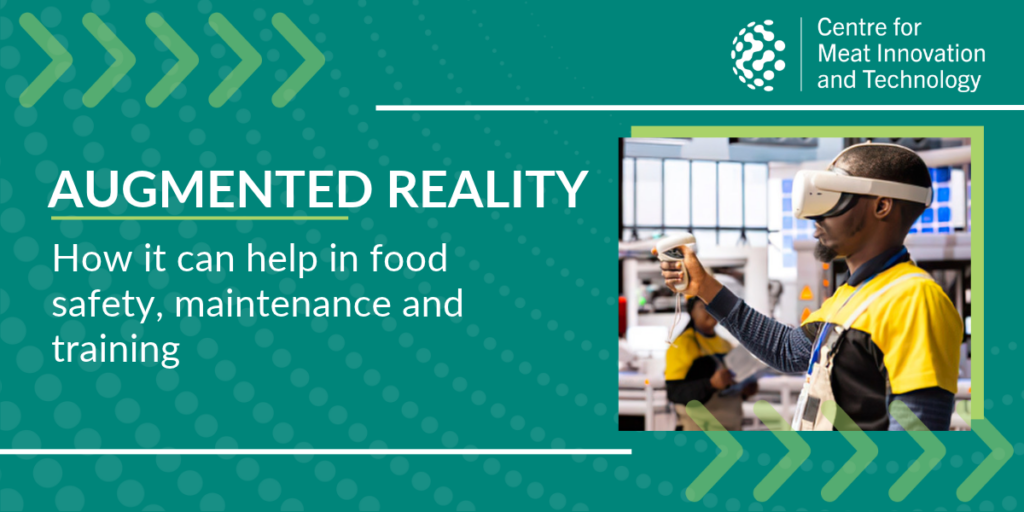
How Can It Help?
By Michael Terry, Content Developer, Harpak-ULMA Packaging, LLC
In the past, engineers would have to wait for equipment to break down before conducting repairs. No set maintenance schedules existed, and diagnostics were inconclusive. Equipment was removed for service, accumulating hours or days of costly unplanned downtime, requiring on-site assistance from available third-party techs.
Today, augmented reality (AR) offers a better path towards efficient, proactive service and maintenance and collaborative remote training between packagers and expert OEMs.
Interconnected AR systems give service personnel the power to collect and monitor system health and performance data in real time, applying limitless diagnostic capabilities to their service, maintenance, and repair processes and offering interactive step-by-step instructions for flawless execution.
In Canada, where food safety standards are among the highest globally, AR can also be used to train employees more effectively by simulating complex scenarios that workers might encounter, as well as assisting companies with compliance and improving traceability in the food industry.
What is Augmented Reality?
Harnessing the full power of AR means understanding its definitions. Augmented reality is a form of Smart Connected technology that creates an interactive digital twin of your existing packaging equipment, overlaid via video within your smart device (VR headset, glasses, tablet, or smartphone). This 3D mirror image acts directly in contact with the object, allowing for real-time service and training activities.
Augmented Reality for Food Safety
One of the primary applications of AR in food safety is in training and procedural compliance. In Canada, AR can be used to train employees more effectively by simulating complex scenarios that workers might encounter. For example, AR can guide workers through proper sanitation processes or highlight areas of potential contamination in real time. According to a report by ABI Research, the global AR market in the food sector is expected to reach $5.1 billion by 2025, a clear indication of the growing reliance on this technology to ensure food safety across the industry.
AR is helping Canadian companies adhere to increasingly stringent food safety regulations. The Canadian Food Inspection Agency (CFIA) mandates strict compliance with protocols to prevent foodborne illnesses. AR can be utilized to conduct remote inspections, allowing supervisors to monitor food safety practices without being physically present. This capability not only saves time but also ensures that safety checks are conducted more frequently and thoroughly. A study by PwC suggests that AR could reduce the time taken to perform certain safety tasks by up to 30 per cent, thereby enhancing overall efficiency and effectiveness in maintaining high food safety standards.
AR technology is improving traceability, which is a critical component of food safety. Canadian consumers and regulators are increasingly demanding transparency about the origins and handling of food products. AR can provide workers with instant access to detailed information about each product, such as its source, processing history, and safety checks it has undergone. This level of transparency helps in quickly identifying and isolating any safety issues that might arise, thereby preventing potential outbreaks of foodborne illnesses.
AR is proving to be a powerful tool in enhancing food safety in Canada and around the world. By improving training, ensuring compliance with regulations, and enhancing traceability, AR is helping meat processors and food companies maintain the highest safety standards, ultimately protecting consumers from potential hazards. As technology continues to evolve, its role in food safety is likely to become even more integral, supporting Canada’s ongoing commitment to leading the world in food safety practices.
Augmented Reality for Maintenance
Many producers are adopting AR for equipment maintenance, service, and repair.
Operators use sophisticated AR tools and software that supports its use to gather and track system data live and proactively create pre-emptive service alerts using condition-based monitoring and predictive analytics. Using this full suite of AR tools, they can identify root causes of component and system failures, take corrective actions, and follow step-by-step interactive instructions to conduct service and repair activities to solve complex equipment issues.
Unlike traditional, reactive processes, these AR-based solutions prevent production interruption, unplanned downtime, and additional service costs from on-site technicians, saving producers up to $250,000 per line in annual potential operating costs and optimizing performance and reporting.
How Augmented Reality Benefits Maintenance
Augmented reality minimizes human error and maximizes system service efficiency. This optimization reduces repair times, provides better availability for connected assets, and minimizes unplanned downtime.
But do AR’s benefits yield a real measured return on investment (ROI) to offset upfront technology and production costs? Yes, and we examine how:
Precision Data & Unplanned Production Downtime:
AR provides a comprehensive understanding of your packaging system through precise performance, health, and compliance data over time. Technicians can use this data to eliminate guesswork, make actionable, data-driven decisions, solve complex challenges in hours, not days, and optimize human production efficiency to avoid unplanned downtime costs (up to $576,[unclear] per day on average).
Set Maintenance Schedules & Overall Equipment Effectiveness (OEE):
AR is the key to proactively creating set maintenance schedules for every connected packaging machine. These standardized schedules let operators monitor system health and compliance and dispatch the right internal or external technician with the precise service or maintenance solution to be proactively solve any issue. This condition-based monitoring and the resulting predictive analytics translate to higher OEE, one point of which has a production value of over $2 million annually.
Augmented Reality for Training
AR is also instrumental in interactive application training. Responding to the labour demands of the new post-great-recession reality, packagers are turning to augmented reality to facilitate essential legacy knowledge transfer and advanced interactive instruction for technical staff.
Augmented reality tools allow technicians to interact with applications digitally during real-time training sessions using sophisticated 3D rendering technology on connected smart devices. Utilizing a digital overlay and recorded media, AR training takes service personnel through step-by-step diagnostic and repair cadences—alone or with an offsite specialist—to solve complex mechanical challenges, providing live feedback to ensure efficacy and the highest engagement, collaboration, execution, documentation, and learning.
How Augmented Reality Benefits Training
The ROI on AR training is efficiency optimization in task completion, data collection, and human productivity.
Data-Driven Efficiency: AR trains technicians to be faster, more accurate, and accountable when finishing service-based tasks. Using AR, packagers can achieve up to 20% increases in human productivity and collect invaluable productivity metrics that can reclaim up to 300 hours of production time annually.
Legacy Knowledge Retention: Packagers can experience up to 120 per cent employee turnover in a calendar year, costing them up to $70,000 in onboarding and training costs per employee. AR training tools capture and store invaluable service knowledge during training and live service functions, empowering technical teams to be more self-sufficient and significantly lowering training costs and Total Cost of Ownership (TCO).
The Future of AR for Maintenance & Training
Packaging machines are getting smarter. More systems are monitoring and maximizing OEE and minimizing downtime (up to 80 per cent). Integrated AI systems are becoming the standard to facilitate self-adjustment and autonomously maintain peak performance.
Until then, forward-thinking packagers should empower their teams with accessible knowledge using AR for new and legacy systems to optimize equipment efficiency and human productivity.
Only through simplified service, operation, and data can we perfect how machines are used in production and how effectively they are serviced in the field.
Augmented reality (AR) is increasingly being recognized as a transformative technology in food safety, offering meat processors and food companies in Canada a novel approach to enhance their safety protocols. By superimposing digital information onto the physical environment, AR enables workers to receive real-time guidance and feedback, ensuring that critical safety measures are adhered to more rigorously. This technology is particularly valuable in environments like meat processing plants, where strict adherence to hygiene and safety protocols is crucial to prevent contamination.