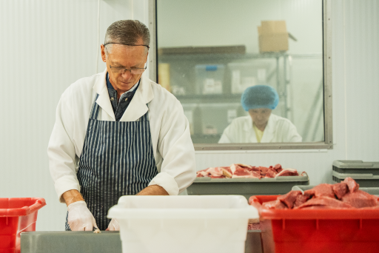
For nearly 50 years, Florence Meats has built its reputation on craftsmanship, quality and personal service. The second-generation Oakville business prides itself on their ‘farm to fork’ philosophy, sourcing from Southern Ontario farms wherever possible to produce its dry-aged beef, smoked meats, poultry and specialty products.
Its signature biltong — a traditional South African air-dried beef snack — is based on a recipe founder Mario Goriup developed in the early 1970s. Today, the business is carried forward by Mario’s son, Damian, Damian’s wife and co-owner, Carol, and their son, Michael.
As Florence Meats prepares to celebrate five decades in Oakville, the family is also preparing for what comes next. Tradition and experience remain one of the business’s greatest strengths, but as the operation grows and long-time employees begin to retire, experience alone cannot carry every process forward.
The next chapter for Florence Meats requires a food safety system that captures that knowledge, supports consistency and helps ensure nothing gets missed.
Looking for the next opportunity to improve
Florence Meats began its food safety improvement journey with confidence in its products and day-to-day practices. The goal was not to respond to a failure, but to proactively build a more structured system supported by streamlined, documented procedures, modernized training and stronger quality assurance.
“Food safety is something that is always important. You can never turn your back on it. You’re always looking for places to improve.” — Carol Goriup
That commitment is especially important because the company produces ready-to-eat charcuterie, including pepperoni, smoked sausages and biltong. “Because of the product that we make, it’s considered a very high-risk product to manufacture,” Damian shares. “And just bringing in a HACCP plan will just strengthen our approach to the business and ensure that we keep on moving forward toward a safe product.”
For the family, working toward a Hazard Analysis and Critical Control Point (HACCP) system offered a way to strengthen an already successful operation while preparing for future regulatory requirements and expanding market opportunities.
Turning a broad goal into a practical pathway with the FSE Program
Carol learned about the Food Safety Excellence (FSE) Program through Meat & Poultry Ontario. Her first step was completing the FSE Self-Assessment Tool on the Centre for Meat Innovation and Technology website.
The quick, anonymous questionnaire helps processors examine their current systems and goals, and then identify an appropriate next step. For Carol, the process was far more accessible than expected: “It was a bit of a no-brainer once that answer came out. I thought, well, we’ve got everything in place. Why not move to the next step?”
“I didn’t realize how easy it was.” — Carol Goriup
At the time Florence Meats participated, Implementation Support was available through the FSE Program. Funded through the Sustainable Canadian Agricultural Partnership (Sustainable CAP), the initiative helped provincially licensed meat processors by covering up to 100% of eligible costs, to a maximum of $30,000 in funding for the implementation of a third-party audited food safety system of their choosing.
Carol calls this support “vital” and “a game-changer”. It provided their operation an opportunity to move important improvements forward with outside assistance. Implementation Support has since been fully allocated, but Florence Meats’ experience demonstrates the value of pairing a clear assessment with practical resources and knowledgeable guidance.
Today, the FSE Program continues to support processors with a number of free resources, including the Self-Assessment Tool, self-paced learning modules, practical templates and resources, recorded webinars, and one-on-one guidance from a food safety specialist. Together, these resources can help businesses identify gaps, formalize procedures and build a realistic path toward their goals.
Protecting knowledge—and passing it forward
The family expects some long-time team members to retire within the next five years. By documenting procedures and modernizing training, Florence Meats can help new employees learn not only what to do, but how to develop the artisan skills behind the products customers have trusted for generations.
“The biggest part of the HACCP journey for Florence Meats is its ability to provide us with documentation and really help modernize our training practices.” — Michael Goriup
The company also plans to bring on a dedicated quality-assurance professional to oversee documentation, procedures and compliance. This will reduce reliance on individual memory and give employees confidence that they are working from the same high standards.
As Michael explains, documentation provides the foundation needed to “train new people to develop that artisan skill.” It is a bridge between tradition and the future, protecting what makes Florence Meats distinctive while creating greater consistency.
Building confidence for the next chapter
Florence Meats is working toward HACCP readiness and future review by the Ontario Ministry of Agriculture, Food and Agribusiness. While these milestones could open up new business opportunities, the benefits of a stronger food safety system begin well before any certification or licence is achieved.
Clear procedures support employees and the product. Reliable records support regulators and consumer trust. Standardized training helps protect product quality and a clear, dedicated system gives owners confidence that these steps are being followed, even as employees and production demands change.
Food safety excellence is not a finish line. It is an ongoing commitment to asking questions, identifying risks and improving the way work is done.
Carol’s advice to processors thinking about improving their food safety systems with the help of the FSE Program is simple: “Go for it. I think it’s worth it. I think you’ll feel more comfortable than you do right now with your program and, at the end of the day, it helps everyone.”
Not sure what your operation’s next step should be? Use the FSE Self-Assessment Tool and receive a recommended next step based on your current food safety system and goals.
Financial support for Food Safety Excellence was provided under the Sustainable Canadian Agricultural Partnership (Sustainable CAP), a five-year, federal-provincial-territorial initiative.
Financial support for Food Safety Excellence was provided under the Sustainable Canadian Agricultural Partnership (Sustainable CAP), a five-year, federal-provincial-territorial initiative.